
Increasing turbine efficiency is crucial for maximizing power output and reducing operational costs in power generation and industrial applications. This article reviews what turbine efficiency is, factors influencing it, how to increase it, and the role of control systems.
What is Turbine Efficiency
Turbine efficiency measures how effectively a turbine converts energy input into mechanical or electrical output. Higher efficiency means lower fuel consumption, thus, minimizing operational expenses. Multiple factors influence a turbine’s overall performance and energy conversion capabilities.
Factors Affecting Turbine Efficiency
There are several factors that influence a turbine’s efficiency, with the following sections highlighting a few of them.
Compression Ratio
The compression ratio determines how much air is compressed before combustion. Higher compression ratios increase thermal efficiency, therefore, allowing more energy extraction from fuel. Optimal compression reduces energy losses as well as improves overall turbine performance.
Pressure Drop and Airflow
Pressure variations and airflow dynamics significantly influence turbine efficiency. Excessive pressure drops reduce energy transfer effectiveness. Whereas, smooth unrestricted airflow ensures maximum power generation and minimizes mechanical resistance that can waste potential energy.
Turbine Inlet Temperature
Higher inlet temperatures can increase thermal efficiency by improving energy conversion processes. However, extreme temperatures cause material stress and potential component degradation. Hence, there is a need to maintain precise temperature management to ensure optimal performance without compromising equipment integrity.
Ambient Conditions
External environmental factors like altitude, humidity, and temperature directly impact turbine performance. Extreme conditions reduce air density, thereby affecting compression and power generation capabilities. As a result, the design of turbines must help maintain efficiency across all conditions in its operating environment.
Mechanical Losses
Friction, vibration, and mechanical wear create energy losses in turbine systems. So, it is important to minimize mechanical losses through lubrication, precision engineering, and regular maintenance. Reducing these losses ensures more efficient power conversion.
Fuel Properties
Different fuel characteristics significantly influence combustion efficiency and energy output. Fuel quality, chemical composition, and heating value determine how effective energy conversion will be. Matching fuel properties to turbine specifications is key to maximizing performance and efficiency.
Maintenance and Operating Conditions
Regular maintenance prevents performance degradation and ensures consistent efficiency. Best practices for maintenance include proper calibration, component alignment, as well as timely replacements, all of which help minimize downtime.
Methods to Increase Turbine Efficiency
Inlet Air Cooling
Advanced cooling techniques can significantly increase turbine efficiency. Some examples include:
- Fogging Systems: A cooling technique that injects microscopic water droplets into the inlet air stream. These droplets rapidly evaporate, hence, reducing air temperature, increasing air density, and improving compressor performance.
- Evaporative Cooling: This method passes inlet air through water-saturated media, leveraging natural water evaporation to lower air temperature. Particularly effective in hot, dry climates, evaporative cooling increases air density and turbine efficiency while providing a cost-effective cooling solution.
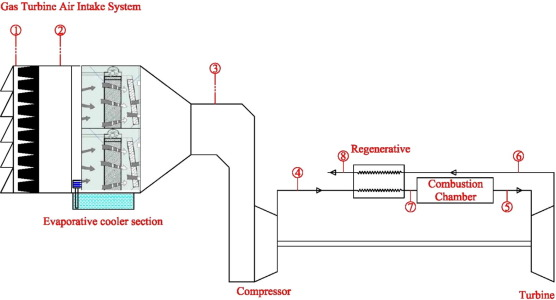
- Inlet Chilling: An advanced refrigeration method that significantly reduces air temperature before entering the turbine. By maintaining optimal air temperature, inlet chilling ensures consistent power output across various environmental conditions. Therefore, enhancing overall turbine performance and efficiency.
Heat Recovery Systems
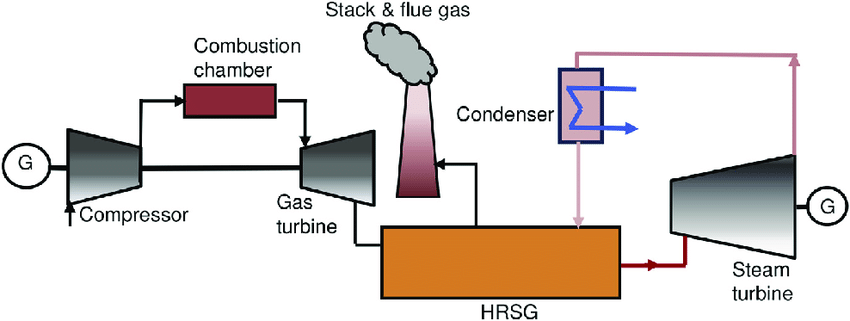
Heat Recovery System Generators (HRSG) capture and reuse waste heat. The primary function of an HRSG is to maximize energy efficiency by creating a cascading energy utilization process. By capturing hot exhaust gases and also using them to generate steam, these systems can significantly increase the overall efficiency of power generation facilities.
Thermal Energy Storage to Increase Turbine Efficiency
Storing thermal energy during periods of low demand enables facilities to create a more flexible and efficient energy ecosystem. The benefits of thermal energy storage extend beyond simple energy conservation to the following areas:
- Improved Grid Stability: Systems balance energy supply and demand by storing excess energy during low-demand periods and releasing it during peak consumption times.
- Reduced Energy Costs: By shifting energy consumption to off-peak hours when electricity rates are lower, facilities can significantly decrease their overall energy expenditure.
- Enhanced Overall System Resilience: Thermal energy storage provides a buffer against energy supply fluctuations, hence, ensuring better consistency and reliability.
Advanced Control Systems
Advanced control systems represent a critical strategy for improving turbine efficiency. By implementing intelligent technological interventions, operators can significantly reduce energy losses and enhance overall performance.
Petrotech’s Expertise in Control System Solutions
Petrotech specializes in developing sophisticated control systems that transform power generation infrastructure. Our solutions focus on upgrading critical components like generator excitation systems, as well as turbine fuel regulation. We provide microprocessor-based digital systems that regulate output voltage, enhance protection, and also enable flexible operational modes.
Mature Application Design
Mature application design is a foundational approach to developing robust control systems. It represents a comprehensive methodology that evolves through extensive operational experience and continuous technological refinement. By prioritizing proven design principles, we create control solutions that deliver consistent, reliable performance across complex industrial environments. Key benefits of mature application design for turbine efficiency include:
- Better reliability through extensive operational testing.
- Minimal risk of system failures.
- Consistent performance across a variety of operational conditions.
- Ability to predict and mitigate potential performance degradation.
- Enhanced system responsiveness to load changes.
The Role of Control Systems in Turbine Efficiency
Control systems are critical for maximizing turbine operational efficiency. By implementing intelligent technological interventions, operators can significantly reduce energy losses and enhance overall performance. These systems provide precise management of turbine operations, enabling optimization of critical parameters.
Petrotech’s diagnostic algorithms represent a sophisticated approach to equipment performance prediction. These intelligent systems continuously analyze multiple operational parameters, identifying potential performance variations before they impact turbine efficiency. Our algorithms can detect subtle changes in equipment behavior, enabling proactive maintenance and also performance optimization.
Petrotech’s Open Architecture Model
The Open Architecture model is a strategic approach to developing flexible control systems. This methodology provides a standardized, flexible solution that enables seamless integration across diverse industrial environments. By leveraging industry-standard programming and non-proprietary hardware, we create control systems that offer unprecedented adaptability and efficiency.
Benefits of Open Architecture Model
Key advantages of the Open Architecture model for turbine efficiency include:
- Seamless integration of new technologies.
- Better system adaptability.
- Helps prevent technological obsolescence.
- Allows for easier upgrade paths.
- Improves interoperability across different systems.
Case Study
In a recent project, Petrotech demonstrated its expertise in improving turbine efficiency through the implementation of advanced control systems. This case study details the modifications and also outcomes of a project involving a GE Frame 5 Gas Turbine driven generator set, aimed at enhancing efficiency and reliability.
Background
The project involved a Power System Operator (PSO) located in New York, USA, where Petrotech and the operations team upgraded an older model GE Frame 5 Gas Turbine. The 25 Megawatt (MW) natural gas-fueled turbine provides black start capability for a gas-fired thermal station consisting of two steam turbine generating units with power outputs of 335 MW and 491 MW. The goal was to improve the turbine’s efficiency and reliability by upgrading the generator control system and the gas turbine fuel control system.
Upgrading the Generator Control System
The original generator had an outdated SCT/PPT (Saturable Current Transformer/Power Potential Transformer) excitation system. After thorough client consultations and a field survey, Petrotech determined that it was necessary to update the voltage regulation system. Because this will enhance unit reliability and integrate with the new Turbine Fuel Regulation (TFR) system.
New Digital Excitation Control System (DECS)
- Petrotech installed a new microprocessor-based DECS, which regulates the output voltage, VARs, or Power Factor of the generator. It achieves this by controlling the amount of DC excitation applied.
- The DECS includes functionality to limit, control, and protect the generator from operating outside its capability.
- Additional installations include a power rectifier, synchronization check relay, and an automatic synchronizer, all integrated with the new TFR system. Thus, enabling the generator to start up in isochronous mode under no load conditions.
Enhancing the Turbine Control System
To further facilitate stable isochronous speed control, Petrotech upgraded the gas turbine speed sensors. Together with the new TFR system, it provided a reliable system capable of operating in either isochronous or droop modes.
Turbine Fuel Regulation (TFR) System
- The TFR system is a collection of mature function blocks with millions of hours of successful gas turbine fuel regulation.
- The system includes capabilities for start-up and operation in either isochronous or droop mode, with smooth transitions between modes under load conditions.
- During isochronous mode, the TFR responds quickly to load rejections and increases to maintain frequency at acceptable levels. Therefore, avoiding overspeed trips and enabling rapid reestablishment of loaded operation.
Implementing the Human Machine Interface (HMI)
Petrotech also enhanced the Human Machine Interface (HMI) to improve operator interaction with the upgraded control systems. The HMI consists of a touchscreen panel-mounted computer providing operators with a graphical display of control system data and status. Modifications include the integration of the speed controller interface, voltage controller interface, as well as status display of the DECS. Others are real-time trending for critical parameters such as speed, exhaust gas temperature, generator voltage, and real power output. These enhancements make for better operator visibility and control over the turbine operations, thus, contributing to more efficiency and reliability.
Outcomes and Benefits
- Increase in Turbine Efficiency: The advanced control systems ensure optimal operating conditions, reducing energy losses and also enhancing overall efficiency.
- Better Reliability: The upgrades provide more stable and reliable turbine operation, hence, reducing the risk of operational disruptions..
- Operational Flexibility: The system’s capability to operate in both isochronous and droop modes allows for efficient operation under various conditions.