
Effective surge control is critical in maintaining the reliability and efficiency of rotating machinery, such as compressors and pumps. This article reviews what surge is, how surge control works, and best practices that ensure equipment optimal performance and longevity.
What is Surge in Compressors
Compressor surge occurs when the mass flow rate through the compressor drops below a critical value, thus, leading to a reversal of flow within the compressor. This phenomenon typically arises during conditions of low demand or when the operating point of the compressor moves too close to a critical boundary, which is the surge line on a performance map.
During a surge event, the flow oscillates back and forth, resulting in unstable performance. This is usually characterized by loud noises, vibrations, and pressure pulsations. In addition, the compressor may experience a complete flow reversal, where gas flows from the discharge back to the suction side. This condition can cause severe mechanical vibrations, impacting the integrity of components such as bearings, seals, and blades.
Anti-Surge Control Systems
Modern anti-surge control systems consist of several components working in harmony to prevent surge conditions. Individual components may vary depending on the type of system, but can be classified into the following:
- Advanced instrumentation and transmitters for process measurements.
- Redundant hardware configurations for system reliability.
- Calibration and surge detection algorithms.
- Control algorithms for surge prevention.
- Final control elements like recycle or blow-off valves.
How Surge Control Systems Work
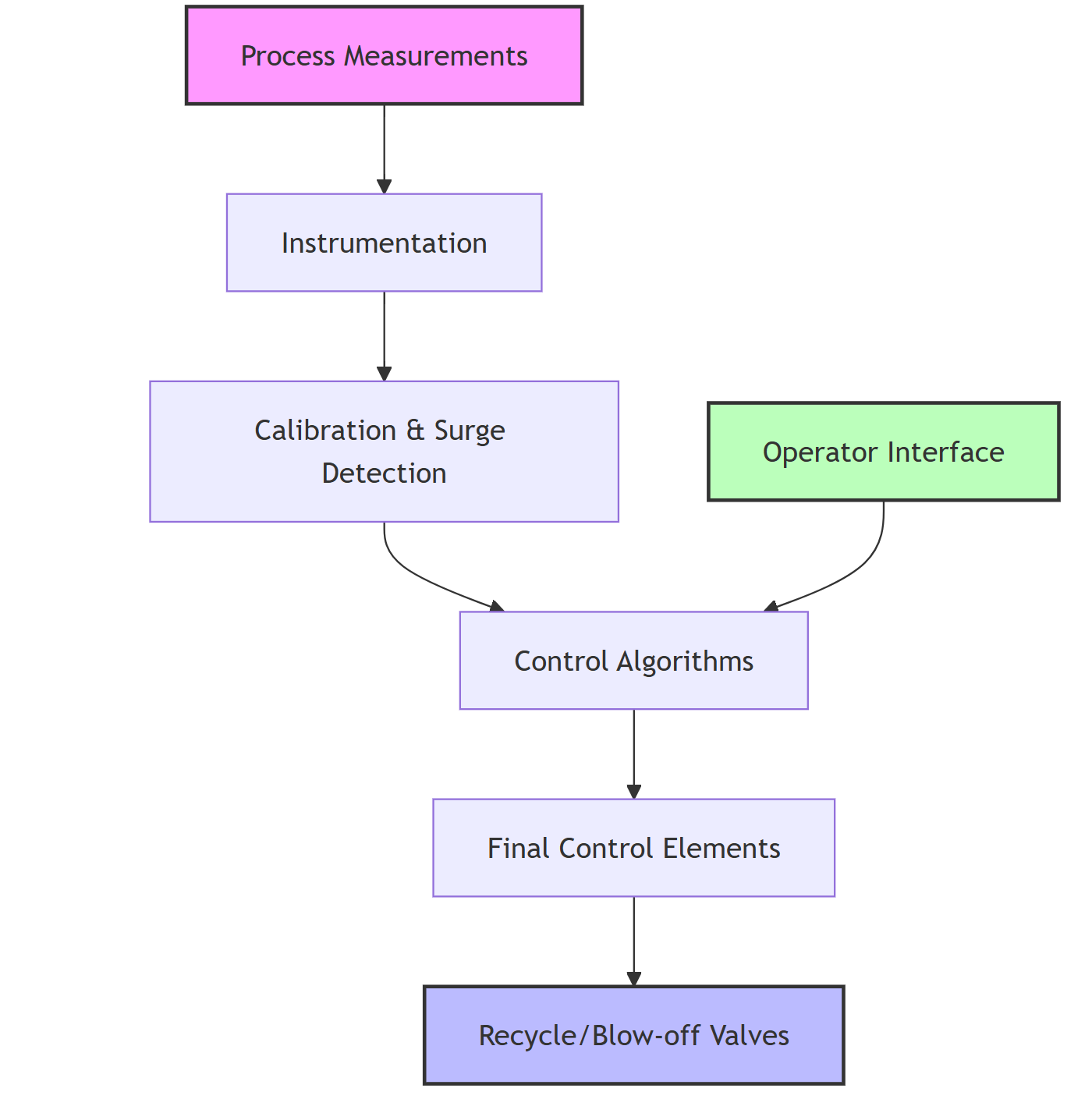
The surge control system operates through a sophisticated network of integrated components. Instrumentation continuously monitors crucial process parameters including pressure, flow, and temperature measurements. These measurements feed into calibration algorithms that determine the compressor’s operating position relative to its surge limit line. When the system detects an approach toward surge conditions, control algorithms initiate precise adjustments through final control elements. This coordinated response maintains safe operating margins and prevents surge events while optimizing system efficiency. The flow diagram below highlights a typical surge control system working procedure.
Best Practices for Surge Control
Generally, control system manufacturers provide guidance on the most suitable surge control for your application, and how best to operate it. However, there are general guidelines, which the following sections highlight.
System Design and Implementation
Proper system design begins with accurate sizing of recycle valves and associated piping. Also, engineers should consider maximum flow requirements and response times when selecting components. Another important factor is redundancy, as this can ensure continuous monitoring capability. Critical measurements should have backup sensors in strategic positions to obtain accurate readings, with automatic switchover capabilities. In addition, the control system should incorporate multiple layers of protection.
Monitoring and Maintenance
Regular calibration of instruments ensures accurate readings and reliable surge detection. So, maintenance teams should establish comprehensive checking schedules for all system components. In addition, there should be proper documentation of all maintenance activities to help track system performance over time. Operators should regularly review surge control system performance data, especially trend data, to identify potential issues before they become critical. This will help in implementing predictive maintenance strategies, which can prevent unexpected failures.
Operational Guidelines
Operating procedures should clearly define startup and shutdown sequences. Operators need thorough training on surge control system operation and emergency response procedures. Utilizing clear communication protocols ensures quick response to potential surge conditions, so it is necessary to develop and maintain detailed troubleshooting guides. These resources help operators respond effectively to various alarm conditions. Carrying out regular simulation training can improve the preparedness of operators for emergencies.
System Integration
Integration with other control systems requires careful coordination. The surge control system must communicate effectively with process control and safety systems. Operating teams should regularly test all system interfaces to ensure proper operation.
Performance Optimization
Regular performance reviews help identify opportunities for system optimization. Operating personnel should analyze surge events to improve prevention strategies. Modern systems deploy data analysis tools to help identify trends and potential issues, therefore, enhancing overall system effectiveness.
Petrotech’s EM-400
The EM-400 Multi-Body Anti-Surge Compressor Controller represents a significant advancement in surge control technology. This system can protect up to three compressors simultaneously using proven algorithms and modern interface design.
EM-400 Alignment with Best Practices For Surge Control
- System Design and Implementation: Our system offers comprehensive protection using multi-layered algorithms, capable of managing up to three compressors simultaneously with built-in redundancy options. It seamlessly integrates with recycle valve assemblies, ensuring optimal surge response and protection. This design guarantees reliable and efficient operation under varying conditions.
- Monitoring and Maintenance: The EM-400 boasts extensive monitoring capabilities, featuring over 45 touch-screen displays that offer detailed sequence logging and event recording. This allows users to track compressor performance live, complete with real-time trend analysis and also comprehensive data logging. With these advanced monitoring features, operators can quickly identify trends and address potential issues before they escalate. Thus, contributing to overall system efficiency.
- Operational Guidelines: Experience enhanced control with the system’s intuitive user interface, which includes integrated alarm management. Users benefit from clear status displays, therefore, making it easy to monitor operations at a glance. The system also implements multi-tiered password protection, ensuring secure access control across various operational levels. This approach not only protects sensitive data but also improves user confidence in operational security.
- System Integration: Integration is a breeze, as the system coordinates seamlessly with existing capacity control systems and plant control infrastructures. Thanks to its design, implementation requires no additional hardware, making it a cost-effective solution. Flexible mounting options accommodate various installation scenarios, thus, allowing for a tailored setup that fits your specific operational needs.
- Performance Optimization: To maximize efficiency, the system employs adaptive algorithms that automatically adjust to changes in molecular weight, temperature, pressure fluctuations, and compressor speed. This smart functionality ensures that performance data is always up-to-date, enabling continuous optimization of the system. By improving efficiency through real-time adjustments, the system not only enhances productivity but also reduces operational costs.