
Centrifugal compressor surge is a critical phenomenon that can significantly impact the performance and safety of compression systems. Understanding surge, its causes, effects, and prevention methods is crucial for maintaining safe and efficient compressor operation. This article delves into what centrifugal compressor surge is, its causes and effects, a typical surge curve, and surge control.
Surge in Centrifugal Compressor
Surge in a centrifugal compressor is an unstable condition where the compressor cannot maintain the required discharge pressure due to low flow rates. This instability causes rapid fluctuations in flow rate, pressure, as well as temperature, often with severe vibrations and noise. Surge happens when flow drops below a critical point, leading to a cyclic pattern of flow reversal and re-establishment.
Effects of Surge
Several issues can arise due to surge in a centrifugal compressor as the following sections highlight.
Mechanical Damage
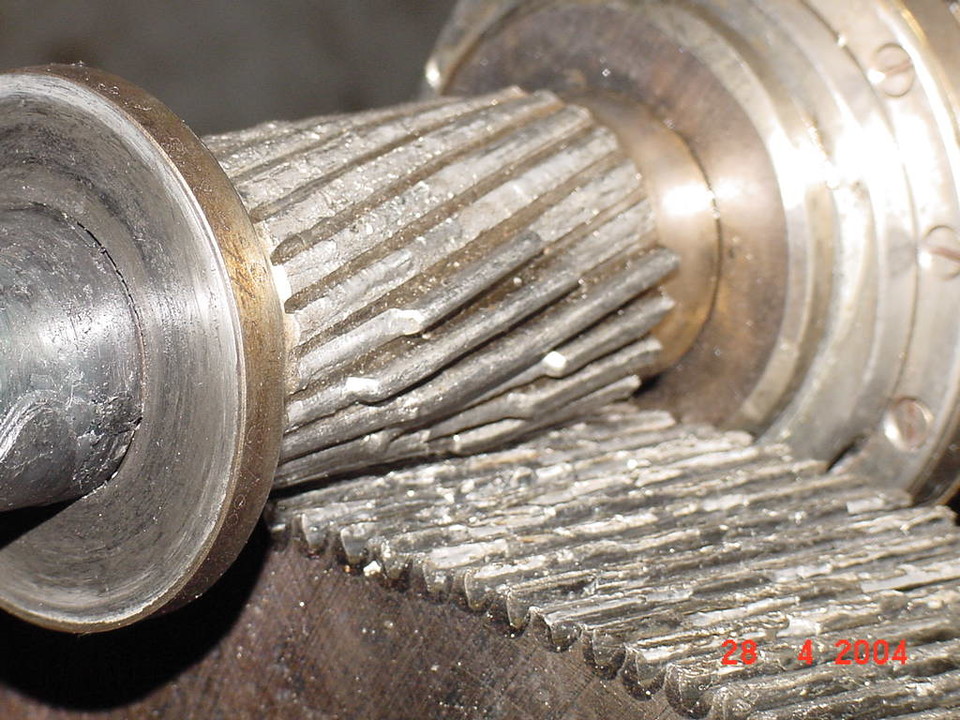
One of the immediate and concerning effects of surge is the potential for mechanical damage to the compressor. The rapid flow reversals and pressure fluctuations during surge can cause:
- Bearing damage: The sudden changes in axial thrust can overload the thrust bearings, leading to premature wear or failure.
- Seal damage: Also, the pressure fluctuations can compromise seal integrity, leading to leaks and reduced efficiency.
Performance Degradation
Surge events, even if brief, can have lasting impacts on compressor performance:
- Decreased reliability: Repeated surge events can cause cumulative damage. Thus, reducing the overall reliability of the compressor and increasing the frequency of maintenance requirements.
- Shortened lifespan: The mechanical stresses induced by surge can significantly shorten the operational life of the compressor and its components.
Process Disruption
In industrial settings, compressor surge can have far-reaching effects on the entire process.
- Production losses: Surge events often necessitate a temporary shutdown of the compressor, hence, production interruptions and associated financial losses.
- Safety concerns: In processes involving flammable or toxic gasses, the pressure fluctuations during surge can compromise containment systems.
Compressor Surge Causes
Understanding the root causes of surge is essential for effective prevention and control. Several factors can contribute to the onset of surge as the following sections highlight.
Low Flow Conditions
When the flow rate through the compressor decreases below the surge point, it’s often due to:
- Increased downstream resistance: For example, a partially closed valve or blockage in the discharge line.
- System demand fluctuations: Sudden drops in demand from downstream processes can lead to low flow conditions.
Rapid Changes in Operating Conditions
Compressors are designed to operate within specific parameters. Sudden changes can disrupt stable operation.
- Inlet temperature fluctuations: Rapid cooling or heating of the inlet gas can alter its density and affect compressor performance.
- Pressure variations: Sudden changes in inlet or discharge pressure can push the compressor towards surge.
Improper System Design
Design flaws in the compressor system can create conditions conducive to surge with examples as follows:
- Undersized or oversized compressor: When compressor size and system requirements do not match, the system is susceptible to surge.
- Inadequate piping design: Having too small or too large piping can increase system resistance and lead to flow instabilities, respectively.
- Improper valve sizing: Valves that are too large or small can cause rapid pressure changes and flow instabilities.
Control System Failures
The compressor’s control system plays a crucial role in preventing surge.
- Anti-surge control malfunction: If the anti-surge system fails to respond quickly enough to changing conditions, surge can occur.
- Instrumentation errors: Faulty flow meters, pressure sensors, or temperature gauges can provide incorrect data, thus, leading to improper control decisions.
- PID tuning issues: Poorly tuned control loops can lead to oscillations that push the compressor towards surge.
Fouling or Damage
The physical condition of the compressor itself can also contribute to surge in the following ways:
- Impeller fouling: Buildup of deposits on impeller blades can alter flow patterns and reduce efficiency, hence, leading to surge.
- Internal damage: Worn bearings, damaged seals, as well as eroded impeller blades can change the compressor’s performance characteristics.
Operating Outside Design Conditions
Compressors are designed for specific operating ranges, so operating outside this range results in malfunction.
- Off-design operation: Running the compressor at speeds, pressures, or temperatures significantly different from design conditions can increase surge risk.
- Process changes: Modifications to the overall process that alter the compressor’s operating point without corresponding adjustments to the compressor system.
Environmental Factors
External conditions can sometimes contribute to surge.
- Ambient temperature changes: Significant changes in ambient temperature can affect inlet conditions and compressor performance.
- Altitude changes: For mobile compressors or those in varying altitude applications, changes in atmospheric pressure can affect surge margins.
Centrifugal Compressor Surge Curve
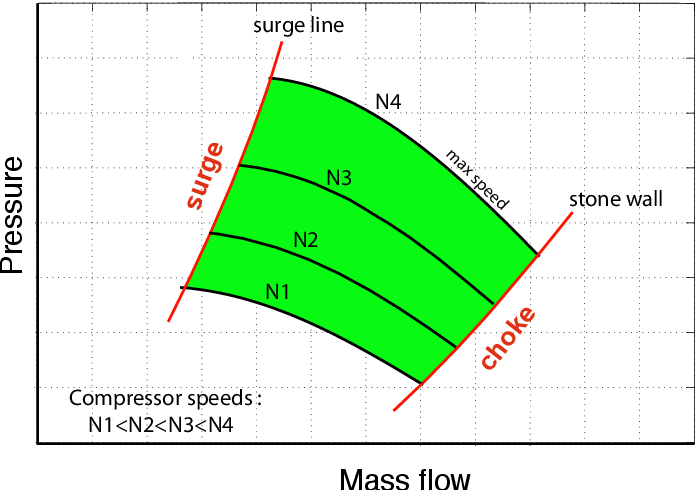
The surge curve shows how a compressor performs by graphing its output pressure against its flow rate. Some key features of a typical centrifugal compressor surge curve are as follows.
Surge Line
This feature of the curve represents the boundary between stable and unstable operation. It is typically a curve that separates the map into two regions. To the right of this line, the compressor operates stably, while to the left, surge conditions can occur.
Choke Line
This line represents the maximum flow limit of the compressor. As flow increases beyond this line, the compressor enters a condition known as “choke” or “stonewall.”
Surge Control Line
This is a safety margin established to the right of the surge line. So, the goal of the control system is to always keep the compressor operating to the right of this line.
Operating Range
This is the area where the compressor can operate safely and efficiently. It is bounded by the surge control line on the left, while the choke line is on the right. Within this range, the compressor can respond to varying system demands while maintaining stable operation.
Best Efficiency Point (BEP)
The BEP represents where the compressor operates at its highest efficiency. Generally, its location is near the center of the operating range.
Speed Lines
These are curves on the map representing the compressor’s performance at different rotational speeds. Generally, they run from the surge line to the choke line, showing how pressure ratio varies with flow at a constant speed.
Efficiency Islands
These are contour lines overlaid on the map showing regions of constant efficiency. They often appear as concentric “islands” with the highest efficiency at the center, typically near the BEP.
Pressure Ratio
The vertical axis of the map usually represents the pressure ratio.
Flow Coefficient
The horizontal axis often uses a dimensionless flow coefficient, rather than absolute flow rate.
Surge Margin
This is not a visible line on the map but a crucial concept. It represents the distance between the operating point and the surge line.
Surge Control in Centrifugal Compressor
Effective surge control is essential for safe and efficient compressor operation. There are several strategies and best practices for detecting, avoiding, and controlling surge.
Anti-Surge Systems
Anti-surge systems are designed to prevent the compressor from operating in the surge region. Key components of an anti-surge system include:
- Instrumentation and Redundant Hardware: Redundancy hardware is incorporated to increase system availability as well as reliability.
- Calibration and Surge Detection Algorithms: These algorithms determine the compressor’s operating point relative to the surge limit line.
- Control Algorithms: These algorithms adjust the final control elements to prevent the operating point from crossing the surge limit line.
- ASC Final Control Elements: When active, these elements move the compressor’s operating point away from the surge limit.
Best Practices in Detecting and Avoiding Surge
| Industry | Best Practices in Detecting Surge | Best Practices in Avoiding Surge |
| Oil and Gas Production | Use pressure sensors and alarms, also carry out regular equipment checks. | Install surge control systems, as well as maintain steady flow rates. |
| Pipeline and Gas Processing | Monitor flow rates, pressure, and use surge detection systems. | Design pipelines with relief valves. |
| Petrochemical and Refining | Employ real-time monitoring and diagnostics. | Install pressure safety valves and also optimize operational procedures. |
| Power Generation | Monitor turbine and compressor performance. | Implement anti-surge systems; balance load changes. |
| Marine | Use pressure and flow sensors, as well as carry out regular inspection of systems. | Install water hammer arrestors; smooth pump operation control. |
| Industrial Automation | Implement automated monitoring and predictive maintenance. | Use soft-start mechanisms; design for optimal flow conditions. |