
Pump control is essential in various industrial sectors, including water treatment, chemical processing, power generation, and the oil & gas industry. These industries depend on precise and dependable pump operations to maintain optimal flow, pressure, and overall process stability. Generally, pump control technologies fall into two main categories: pneumatic and electronic systems. Although both regulate pump performance, they differ significantly in terms of their operational principles, applications, and control capabilities.
This article examines the key differences between pneumatic and electronic pump control systems, focusing on their design, operation, and performance characteristics. It outlines the advantages and limitations of each technology. In addition, it discusses common industrial applications and provides practical criteria for selecting the most suitable pump control solution.
What Is Pump Control?
Pump control is the automated or semi-automated regulation of fluid flow and pressure within a system to ensure efficient and safe pump operation. This control system has several main objectives, including the following:
- Maintaining safe operating conditions.
- Protecting equipment from damage.
- Optimizing energy use.
- Keeping process parameters such as flow rate and pressure within specified limits.
Pump control systems can also be categorized as open-loop or closed-loop. Open-loop systems operate without feedback, thus running pumps based on preset schedules or conditions. Whereas, closed-loop systems use real-time feedback from sensors, including flow meters and pressure transducers, to adjust pump performance continuously and precisely. This feedback-driven control improves system stability, energy efficiency, and responsiveness.
Common control methods use variable frequency drives to adjust pump speed. This improves energy efficiency and ensures reliable process management in industries such as water treatment, chemical processing, and oil and gas.
Overview of Pneumatic Pump Control Systems
Pneumatic systems regulate pump operation using compressed air to actuate control valves or pump pistons based on specific pressure settings.
Key components consist of:
- Air Compressors: Generate and supply compressed air to power the system. Different types, such as reciprocating and rotary screw compressors, are selected based on application demands.
- Pressure Regulators: Maintain consistent air pressure to prevent fluctuations that could affect control accuracy.
- Pneumatic Actuators: Convert air pressure into mechanical motion, driving pistons or valves to control fluid flow and pressure.
- Manual or Pilot-Operated Controllers: Use mechanical feedback and analog signals, often via small pilot air inputs, to operate larger actuators.
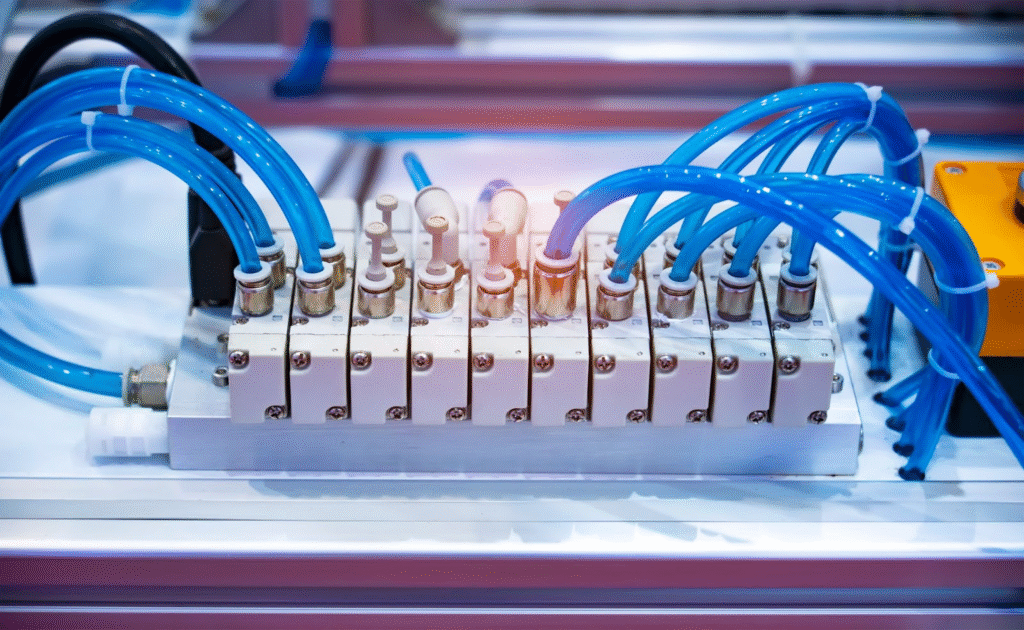
Control logic for pneumatic pumps predominantly relies on mechanical feedback and analog modulation rather than digital electronics. Compressed air flows through valves to move pistons or diaphragms, effectively regulating fluid parameters. This approach is favored in industrial settings because of its simplicity, reliability, and inherent safety in hazardous environments.
Overview of Electronic Pump Control Systems
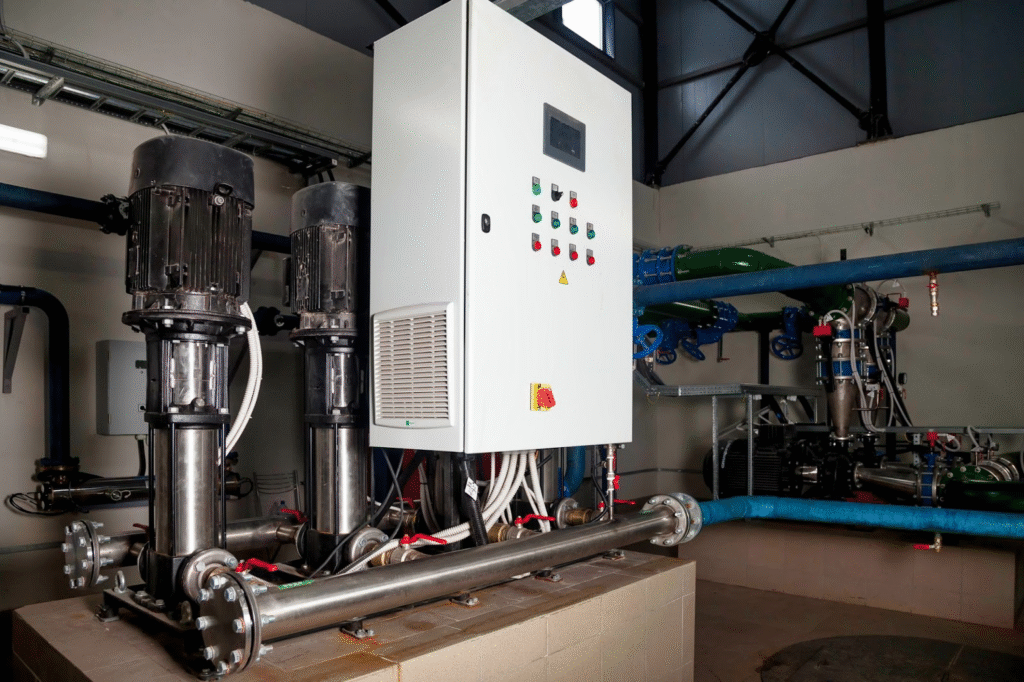
Electronic pump control systems manage pump operation through sensors, programmable logic controllers (PLCs) or microcontrollers, and electric actuators. These systems use software-based logic to provide precise regulation.
Typical components include:
- PLC or Microcontroller: The central processing unit that runs control software and communicates with sensors and actuators.
- Pressure and Flow Sensors: Provide real-time feedback to monitor and adjust pump operation.
- Variable Frequency Drives (VFDs): Adjust motor speed electronically, enabling smooth control of pump flow and pressure while optimizing energy consumption.
- Digital Displays or Human-Machine Interfaces (HMIs): Facilitate operator interaction for monitoring, configuration, and diagnostics.
Control logic in electronic systems commonly supports proportional-integral-derivative (PID) control for precise setpoint tracking and adapts to changing process conditions. These systems can also integrate with supervisory control and data acquisition (SCADA) or distributed control systems (DCS) for centralized monitoring and automation.
Key Differences Between Pneumatic and Electronic Pump Controls
| Feature | Pneumatic Pump Control | Electronic Pump Control |
| Power Source | Compressed air from air compressors powers actuators. | Electricity powers motors and electronic controllers. |
| Precision | Moderate due to limited by air compressibility and mechanical parts | High due to precise control via sensors, PLCs, and VFDs. |
| Response Time | Slower due to pneumatic dynamics and mechanical actuation. | Fast, near-instantaneous electronic feedback and control. |
| Maintenance | Simple mechanical upkeep as the air system requires maintenance. | More complex, as the controller involves hardware and software updates. |
| Installation | Robust; suitable for hazardous or harsh environments. | Sensitive to harsh conditions: requires electrical infrastructure. |
| Control Logic & Scalability | Limited analog/machine logic. | Advanced digital logic; highly programmable. |
| Environment Suitability | Intrinsically safe; ideal for explosive, wet, dusty locations. | Best in controlled, enclosed facilities. |
| Energy Efficiency | Lower due to continuous air consumption and leakage losses. | Higher due to variable motor speed control reducing energy use. |
| System Integration | Difficult to integrate with modern automation. | Easily integrates with SCADA, IoT, and industrial networks. |
Advantages of Pneumatic Pump Control
- Explosion-Proof Operation: Lacks electrical circuits, making it inherently safe for hazardous areas such as refineries and chemical plants.
- Simple and Reliable: Mechanical design with fewer failure-prone components, ideal for rugged and outdoor environments.
- Cost-Effective: Lower initial installation and equipment costs, especially suitable for small-to-medium scale systems.
- Low Power Requirements: Operates solely on compressed air, thus eliminating the need for electrical power in some applications.
Limitations of Pneumatic Pump Control
- Less Precise: Difficult to achieve fine-tuned flow and pressure control due to lack of electronic feedback.
- Slower Response Time: Mechanical actuators result in delayed system reactions.
- Limited Remote Monitoring: Generally lacks built-in diagnostics or remote feedback capabilities.
- Energy Inefficiency: Compressed air generation and continuous consumption lead to higher energy use compared to electric systems.
Advantages of Electronic Pump Control
- High Accuracy and Speed: Real-time sensor feedback enables precise and rapid adjustments.
- Programmability: Software-based logic enables the implementation of advanced control strategies such as PID tuning, safety interlocks, and customized flow profiles.
- Remote Monitoring and Diagnostics: Easily integrates with SCADA, IoT, and digital control networks for comprehensive monitoring and troubleshooting.
- Energy Efficiency: Variable frequency drives (VFDs) and optimized control algorithms reduce power consumption.
Limitations of Electronic Pump Control
- Environmental Sensitivity: Requires protection from heat, dust, moisture, and electromagnetic interference (EMI).
- Higher Initial Cost: More expensive components and complex system setup increase upfront expenses.
- Maintenance Demands: Requires skilled technicians for software updates, troubleshooting, and hardware maintenance.
- Power Dependency: Needs a stable power supply with backup solutions to avoid operational interruptions.
Common Applications of Pneumatic vs Electronic Controls
Pneumatic Applications
Oil and Gas (Hazardous Zones)
Pneumatic controls are preferred in explosive environments because they do not need electricity in hazardous areas. This eliminates any risk of sparks that could ignite flammable gases or vapors.
Mining and Quarrying (Rugged Environments)
Robustness and durability of pneumatic systems suit harsh, dusty, and wet conditions where electrical systems can fail.
Water/Wastewater Plants with Minimal Automation
Simplicity and reliability make pneumatics ideal for basic control needs with limited digital integration.
Electronic Applications
Chemical Dosing Systems
Require high precision and programmability provided by electronic controls with sensor feedback and PID logic.
HVAC Systems in Commercial Buildings
Electronic controllers enable integration with building management systems and fine control over temperature and air flow.
Industrial Manufacturing
Automated filling, batching, and pressure regulation utilize electronic controls for accuracy, speed, and integration with factory automation.
Smart Municipal Water Distribution
Electronic controls offer remote monitoring, diagnostics, and integration with SCADA/IoT platforms for optimal water management.
Control System Selection Criteria
Use the following criteria to determine the most suitable pump control system for a given application:
| Criterion | Selection Considerations |
| Environment | Choose pneumatic controls for explosive, dusty, or wet conditions due to inherent safety. Electronic controls require safeguarded, stable environments. |
| Precision | Use pneumatic systems for moderate accuracy needs. Opt for electronic controls when high precision and advanced tuning (e.g., PID) are essential. |
| Scalability | Pneumatic systems suit simpler, standalone applications. On the other hand, electronic systems excel in scalability, complex logic, and network integration. |
| Maintenance | Pneumatics demand straightforward mechanical maintenance. Electronics need skilled personnel for software and hardware upkeep. |
| Cost | Pneumatics have lower initial expenses but higher operational energy costs. Electronics entail higher startup investment with better energy efficiency and diagnostics. |
| Compliance | Pneumatic systems are naturally explosion-proof and often meet hazardous area certifications by design. But electronic systems require explicit certification and protective measures. |
Hybrid Systems and Integration Possibilities
Hybrid pump control systems combine pneumatic actuators with electronic controllers to achieve robust mechanical motion alongside precise and programmable control. Electronic logic controllers such as PLCs operate pneumatic valves by sending control signals to solenoid or proportional valves. This approach is especially useful in intrinsically safe or hazardous zones.
Modern PLCs include both analog and digital input output modules. This allows them to integrate pneumatic devices that use analog pressure or position signals with electronic systems seamlessly. These hybrid systems improve control flexibility, safety and diagnostics while maintaining pneumatic reliability. They are widely used in industrial automation for scalable and safe control across various environments.
Petrotech’s Expertise in Pump Control Solutions
At Petrotech, we deliver advanced pneumatic and electronic pump control systems designed for reliable, automated operation in industrial and hazardous environments. Our solutions include features such as automatic start, engine and pump protection, continuous monitoring, and controlled shutdown.
Our systems are expertly integrated into large-scale SCADA and DCS platforms with open architecture designs, enabling seamless deployment, flexible deployment, and scalability. We provide comprehensive lifecycle support to ensure long-term reliability and optimized performance. To learn more about our pump control solutions, please visit our Pump Control Systems page.