
Introduction
Hydropower accounts for approximately 16% of global electricity generation and is the largest source of renewable electricity. Behind every megawatt delivered to the grid lies the formidable task of managing variable power demands while preserving optimal turbine performance. Maintaining grid stability demands the proactive safeguarding of assets against unplanned outages and excessive wear. At the core of addressing these operational demands is the implementation of effective turbine load control. This is the sophisticated orchestration of power output that responds to real-time demand while keeping system frequency stable. As renewable energy sources like wind and solar add variability to modern grids, hydropower plants must become even more flexible and responsive. This demands intelligent control strategies that maximize efficiency without compromising the mechanical integrity of turbine components.
Petrotech addresses these challenges through proven solutions such as advanced load distribution algorithms, speed droop control systems, and automatic load control (ALC) technologies. In this article, we will explore the essential strategies for effective turbine load control. We will examine coordinated setpoint distribution, speed droop response, and automatic load control. Finally, we will explore how Petrotech’s integrated solutions enable hydropower plants to navigate the evolving demands of modern power grids.
Understanding Turbine Load Control
Turbine load control regulates water flow through turbines to maintain desired power output while protecting system stability and equipment. The control system continuously monitors parameters such as head and tail water levels, flow rates, power output, turbine speed, and wicket gate positions to optimize performance.
How Load Distribution Impacts Plant Performance
- Efficiency: Proper load distribution keeps turbines operating near their best efficiency point. When properly managed, Francis turbines can achieve efficiencies exceeding 90% and up to 95% under optimal conditions. Poor distribution forces some units into inefficient partial load operation, wasting water resources and reducing overall plant output.
- Frequency Stability: Load distribution directly determines how quickly plants respond to grid disturbances. When load is balanced across multiple units, each turbine can adjust its output proportionally to frequency deviations. This coordinated response stabilizes grid frequency faster than relying on individual units operating at capacity limits.
- Equipment Reliability: Balanced load distribution prevents mechanical stress and extends equipment life. Operating below 60% of design capacity can trigger cavitation, pressure fluctuations, and mechanical damage. Coordinated control ensures units operate within safe ranges while avoiding the wear caused by frequent starts, stops, and extreme load swings.
Key Challenges in Load Management
- Fluctuating Demand: Hydropower plants must ramp up or down quickly to match changes in power consumption throughout the day. This requires control systems that can redistribute load across units in seconds while maintaining stability.
- Water Flow Variability: Available hydraulic head changes with reservoir levels, seasonal rainfall, and upstream demands. Lower head reduces available power, thus forcing operators to adjust which units run and at what loads. Drought conditions may require running more units at lower individual outputs.
- Grid Synchronization: Maintaining system frequency within narrow tolerances becomes harder as grids incorporate variable renewable sources. Hydropower must compensate for sudden drops in wind or solar generation. This demands precise coordination between turbine governors and grid frequency signals to deliver the right amount of power at exactly the right time.
Coordinated Load Setpoint Distribution
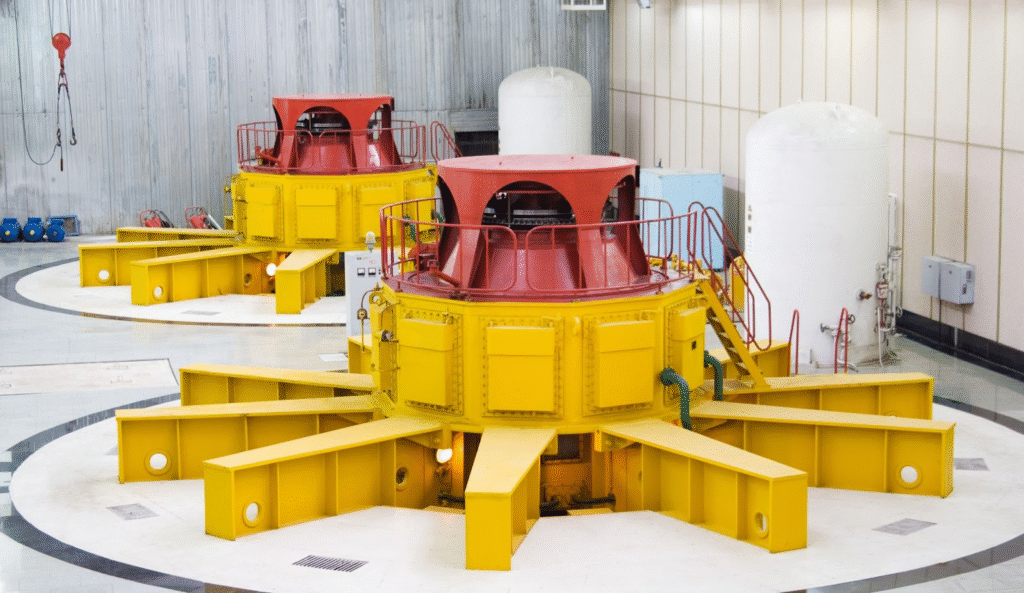
Coordinated load setpoint distribution strategically manages power output across multiple turbine units to achieve optimal efficiency and reliability. Each turbine has distinct efficiency curves and operational constraints that must be balanced to maximize plant performance.
The control system continuously analyzes individual unit performance, available water pressure, and physical limitations to divide workload optimally. Advanced algorithms consider cavitation risks, mechanical wear limits, and maintenance schedules to keep every turbine working efficiently.
Why Balancing Matters:
- It prevents overloading of individual units while maximizing utilization of available water resources.
- It maintains each turbine near its best efficiency point, which typically occurs at 85-95% of rated capacity depending on turbine type.
- Coordinated control reduces hunting behavior and system oscillations that can occur when multiple units compete for load without proper coordination.
Speed-Droop Control and Frequency Response
Speed-droop control mechanism automatically adjusts turbine power output in response to frequency deviations. This control strategy enables multiple generators to operate in parallel while responding to changes in load proportionally based on nameplate ratings and droop settings.
The Speed-Droop Response Mechanism
When grid frequency drops below the nominal 50/60 Hz (indicating increased load demand), turbines automatically increase their power output to help restore frequency balance. Conversely, when frequency rises above nominal (indicating decreased load demand), turbines reduce their power output to prevent over-frequency conditions.
The relationship is linear and instantaneous:
- Frequency decreases → Power output increases.
- Frequency increases → Power output decreases.
Droop Settings and Response Characteristics
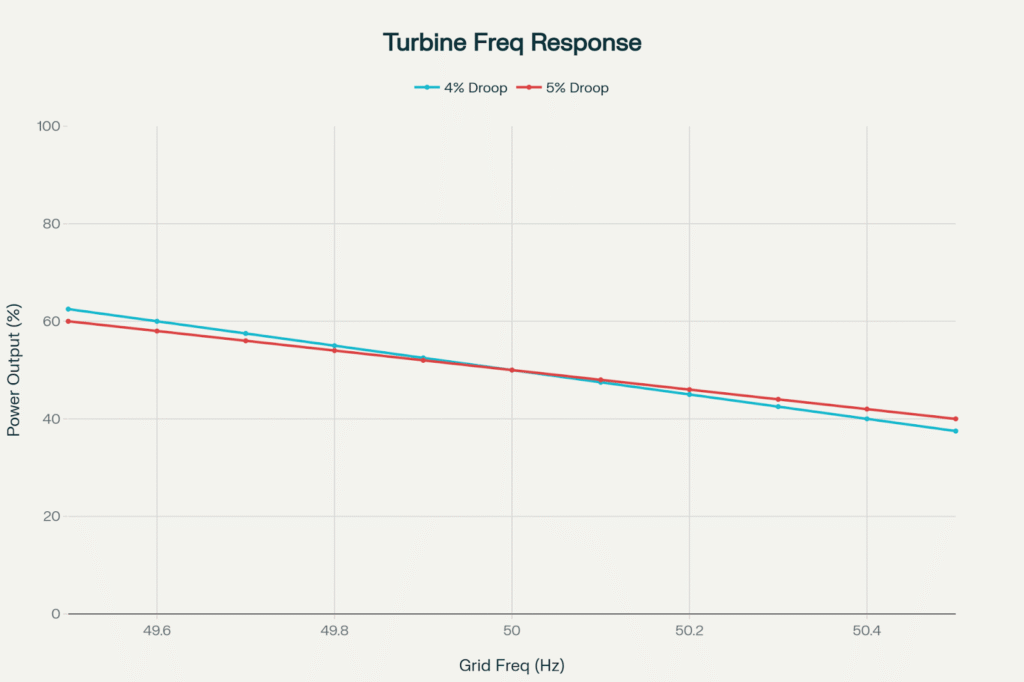
The chart above illustrates two common droop settings used in hydropower plants:
4% Droop Setting (Blue Line)
This means the turbine adjusts its power output more quickly when the grid frequency changes. For each 1% change in frequency, the turbine changes its power by 25% of its full capacity. This setting helps the turbine respond strongly during power disturbances and support grid stability.
5% Droop Setting (Red Line)
This setting makes the turbine respond more slowly. For each 1% change in frequency, power output changes by 20% of full capacity. It provides a steadier response and helps avoid excessive fluctuations or hunting in the control system.
Practical Grid Support Benefits
This automatic frequency response provides several critical grid services:
- Primary Frequency Regulation: Turbines respond within seconds to frequency deviations, thus providing the first line of defense against grid disturbances.
- Load Sharing: Multiple generators with similar droop settings automatically share load changes proportionally without requiring communication between units.
- Grid Stability: The distributed nature of droop control enhances overall system resilience, maintaining stability even during communication failures.
Governor Tuning and Automatic Load Control (ALC)
Turbine governors control speed and power output by precisely adjusting water flow via wicket gates. Proper tuning of these governors, typically using PID control algorithms, is critical to avoid unstable oscillations or sluggish responses that can disrupt grid stability. Aggressive tuning risks constant hunting around setpoints, while overly cautious settings slow the system’s reaction to frequency changes. Modern digital governors allow fine-tuning to match specific site conditions, enhancing both stability and responsiveness.
Automatic Load Control (ALC) is an advanced system that automates load adjustments across turbines in real time, responding to grid demands efficiently. ALC minimizes operator workload, distributes loads optimally, and handles sudden changes smoothly. It can prioritize critical loads, shed non-essential ones during constraints, and support remote operation, including managing multiple sites via satellite or cellular links. With predictive algorithms and condition monitoring, ALC improves maintenance and integrates renewable energy forecasts for balanced, reliable grid support.
Challenges in Turbine Load Management
- Water Availability: Seasonal changes and droughts limit water flow, reducing power generation flexibility.
- Grid Code Compliance: Modern grids demand strict adherence to frequency response, voltage regulation, and cybersecurity standards. This necessitates regular system upgrades.
- Sudden Load Changes: Rapid shifts in demand or emergency shutdowns require turbines to adjust quickly without causing mechanical stress or damage.
- Aging Infrastructure: Many plants still use outdated analog or mechanical controls, limiting their responsiveness and precision. Modernization is essential.
- Cybersecurity Risks: Digital control systems face threats that can disrupt operations, thus robust cybersecurity is crucial for safe, reliable control.
Case Example: Petrotech Hydro_TR Turbine Load Control in Run-of-River Hydropower
Petrotech deployed the Hydro_TR system in a run-of-river hydropower plant to optimize turbine load control through precise wicket gate positioning. The system continuously monitors key operational signals such as water head, flow, turbine speed, and gate position. It then applies advanced control algorithms that regulate water flow, maintain reservoir levels within licensing limits, and maximize power generation efficiency.
Key outcomes of this implementation included:
- Improved load distribution by coordinating multiple turbine units to operate at their most efficient gate positions relative to changing river flow conditions.
- Enhanced frequency stability via optimized speed-droop control, supporting grid reliability during load fluctuations.
- Reduced mechanical wear and extended turbine lifespan due to smoother start-up/shutdown sequences and integrated protection features.
- Increased operational flexibility through modular and scalable design, enabling easy expansion and integration with existing infrastructure.
Achieving Optimum Turbine Load Control Using Petrotech’s Control Systems
Efficient turbine load control is critical for reliable and sustainable hydropower generation. Precise control strategies such as coordinated setpoint distribution, speed-droop control, and Automatic Load Control (ALC) are shaping the future of renewable grid participation. They enable hydropower plants to provide essential grid stability services while maximizing generation efficiency.
At Petrotech, we combine decades of expertise in turbine automation with advanced, flexible control technologies. Our Hydro_TR system continuously monitors key process parameters and dynamically adjusts turbine load to optimize performance, ensure regulatory compliance, and reduce mechanical stress. The system’s modular, scalable architecture supports everything from single units to large, distributed hydro fleets with seamless integration to existing infrastructure.
By partnering with Petrotech, hydropower operators gain a trusted, innovative ally committed to automation and modernization. We provide turnkey engineering, installation, and support services to help you future-proof your hydropower operations and achieve operational excellence.
Contact us today to discover how our proven control solutions can optimize turbine load management for your hydropower plant and help you meet the demands of tomorrow’s energy landscape.